
Latest
18 Inspirational Equestrian Quotes December 12, 2015 12:04
Over the last couple of months we've posted these quotes on our Twitter and Facebook profiles. We've then collected the quotes which our followers found the most inspiring. In this blog post, we'll bring you the top equestrian quotes which have received the most likes, shares and retweets. If you feel inspired after reading these quotes, please share!
1. If you have gained the trust of a horse, you have won a friend for life.
2. The essential joy of being with horses is that it brings us in contact with the rare elements of grace, beauty, spirit and freedom.
3. Horses do not care how much you know until they know how much you care.
4. Some horses will test you, some will teach you, and some will bring out the best in you.
5. Every rider has that one special horse that one horse who changes everything about them.
6. Don't follow your dreams. Chase them!
7. If you are fearful, a horse will back off. If you are calm and confident, it will come forward. For those who are often flattered or feared, the horse can be a welcome mirror of the best in human nature.
8. The best therapist has fur & hour legs.
9. The horse, with beauty unsurpassed, strenght immeasurable and grace unlike any other, still remains humble enough to carry a man upon his back.
10. A life without horses, is like taking a breath without air.
11. No hour of life is wasted that is spent in the saddle.
12. To ride a horse is to ride the sky.
13. It's not a hobby, It's a lifestyle.
14. One day you will wake up and there won't be any more time to do the things you've always wanted. Do it now. 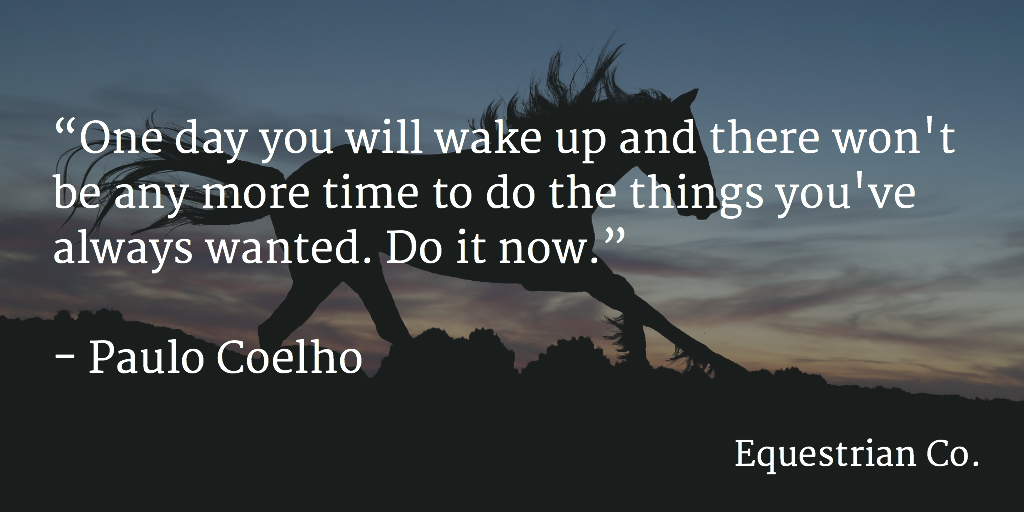
15. Do more of what makes you happy!
16. Ride More. Worry Less...
17. Happiness does have a smell!
18. It doesn't matter how good you are, it matters if you have the passion.
What is a Pony? December 09, 2015 09:00
Many young girls and boys dream of having their own pony. What actually makes a pony a pony? How is a pony different from a horse? Are there ponies that are not really true ponies?
Ponies
A pony (from poulenet, from the French meaning foal) is a small horse that, generally speaking, grows no more than 14.2 hands high (58 inches or 147 cm) when measured at the withers – the high point on the pony’s back where it meets the shoulder. In addition to size, ponies are different from horses in several ways. Ponies tend to have thicker manes and tails, are more closely coupled (have shorter backs), tend to be stockier in build, and have shorter strides than horses. Although not universally true, some ponies have a stubborn streak.
Ponies and Horses
Similar to horses, there are numerous breeds of ponies including the Welsh pony, the Shetland pony, and the Connemara. Although referred to as ponies, polo ponies are not ponies in the truest sense, but are adult horses. Horses who “pony” racehorses on a racetrack are also not true ponies, but are also adult horses. Miniature horses are a specific type of very small horse and there are miniature pony breeds, too.
Versatility of the Pony
Ponies are very versatile! Ponies are used for riding, driving, jumping, eventing, in dressage competition, for fox hunting, trail riding, and much more! Both children and small adults can ride ponies, and both will often begin learning to ride a horse by riding a pony first. Very young children will even learn to ride on the smallest of small ponies before graduating to a larger pony, then to a horse. And, ponies often play the role of companion to horses by serving as pasture buddies.
Owning a pony is a dream of children and adults. Taking your pony to horse shows or pony club events, exploring winding trails on the back of your pony, or running out to the barn after dinner to groom your pony and feed it carrots and apples – ponies provide experiences that last a lifetime!
Buy Equestrian Supplies
| Ladies' Equestrian Clothing | Men's Equestrian Clothing | Children's Equestrian Clothing |
| Horse Tack | Stable & Field Equipment | Pet Supplies |
What is a Gelding? Mare? Stallion? December 07, 2015 14:30
There are essentially three types of “genders” of horses – mares, stallions, and geldings. Stallions are male horses. Mares are female horses, and geldings are castrated male horses. It is important to know these differences especially when deciding what gender of horse you need.
Mares
Mares are rarely spayed like dogs and cats are, first because it is a complicated surgical procedure and second because it is not necessary. Almost all mares are easy to take care of and are very rideable. It also enables owners to breed a mare if they choose to do so.
Stallions
A stallion is almost always kept a stallion for breeding purposes. For example, top winning racehorses might end their racing careers early to begin a breeding career in order to continue top performance lines; a top show jumper may also be kept a stallion while continuing their jumping career.
Unlike mares, stallions can be difficult to handle and if not handled appropriately can put other horses and people in danger. Stallions have a strong breeding instinct. As a result, they will fight other stallions and geldings to be the dominant horse in a herd. This behavior can include rearing, biting, kicking, and striking out with their front legs. Keep in mind that a horse usually weighs a thousand pounds or more. It is near impossible for someone to control a highly energized stallion safely.
Geldings
A gelding is a stallion that has been castrated. Unlike spaying a mare, castrating or gelding a stallion is a fairly straightforward procedure. Veterinarians recommend that a male horse be gelded between the ages of three months and one year. After a year, testosterone levels are such that the horse’s behavior is impacted so that it is more stallion–like. Once a male horse is gelded, it becomes easier to train, ride, and handle.
Not all mares are mare-ish, not all stallions exhibit aggressive behavior, and not all geldings are perfectly behaved. However, knowing the general tendencies of each “gender” will greatly help you to decide what kind of horse best meets your needs.
Buy Equestrian Supplies
| Ladies' Equestrian Clothing | Men's Equestrian Clothing | Children's Equestrian Clothing |
| Horse Tack | Stable & Field Equipment | Pet Supplies |
Training Your Horse to Lunge - a Comprehensive Guide December 03, 2015 13:00
Lunging (also spelled “lungeing”) is an effective way to not only train your horse, but as an alternative method of exercising your horse. It is also the basis for the sport of equine vaulting, is used to start training a horse, to teach someone to ride a horse as well as to improve a rider’s seat. Once you have taught your horse how to lunge, you can use this training technique to enhance its training, such as teaching your horse to jump or using side reins to improve your horse’s way of going.
You will need several pieces of lunging equipment to teach your horse how to lunge including: a halter/head collar, a lunge line/rein, a lunge whip, and good grip gloves. Some people will use a cavesson instead of a halter. This is personal preference as either piece of equipment can be used. In addition, you will need to have access to a flat space – either outdoors or indoors – where you can have your horse do a minimum of a 20-meter circle around you. You can also teach your horse to lunge in a round pen of that is at least 20 meters in diameter.
With the lunge line attached to the halter and holding a lunge whip by your side 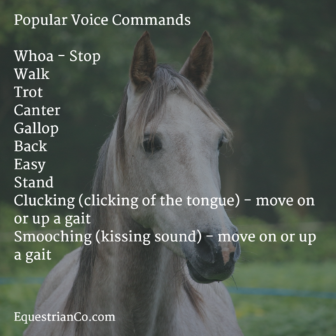 (while wearing gloves with a good grip), lead your horse into the area where you will be training. Start by leading your horse in a small circle around you at a walk. If your horse gets excited and/or pulls away from you, drop the lunge whip on the ground, say “whoa” or “stand” and calmly walk up to your horse and begin the process again by walking your horse in a small circle around you. By using voice commands, your horse will learn that “whoa” or “stand” means to stop; “walk” means to walk; “trot” means to trot; and “canter” means to canter. Saying each command differently will help your horse learn the commands. For example, saying “w-a-a-l-l-k-k” by drawing out the a, l, and k; saying “trot” crisply; and saying “can-ter” as two long syllables clearly distinguishes each command.
As your horse is able to calmly walk around you in a small circle you can begin letting out the lunge line farther and farther so that your horse is making a larger circle until your horse is as far out as the lunge line can allow. If your horse is hesitant to move away from you, slowly point the end of the lunge whip between their wither and their rump, encouraging them to move away from you while simultaneously extending your arm away from your body to also encourage your horse to continue forward on the circle. When lunging your horse, remain in the center of the circle with your body aligned with the horse’s mid-point, located just behind their withers.
Once your horse is able to walk a 20-meter circle around you, you can ask your horse to trot using your voice, a small cluck, and gently encouraging your horse to move forward with the lunge whip if needed. When the walk and trot have been mastered, you can introduce the canter.
There are several things to remember when training your horse to lunge on a lunge line. Horses learn at different rates. Some learn faster than others, so you need a great deal of patience. Remain calm and be consistent in your aids including your voice commands. When you ask your horse to stop, use either the word “whoa” or “stand”. Trot means that the horse should trot; canter means that the horse should canter. If you do not use the same words with the same inflection, your horse will become confused.
You will want to lunge your horse in both directions – to the left and to the right – as well as through all three gaits. To safely turn your horse in the other direction at the end of the lunge line, tell your horse to “whoa”, then ask them to go the other way. If your horse has been lunging to the left and you want them to circle to the right, “whoa” your horse, move the lunge line from your left to your right hand, and move the lunge whip from your right to your left hand. Reposition yourself by walking around the front of your horse. You are then prepared to ask your horse to walk in the opposite direction.
Once your horse is able to work through all three gaits in both directions, you can mix things up by having your horse work through different transitions (walk to canter, canter to walk, trot to canter back to trot, etc.). As your horse learns your voice commands, you can un-do the lunge line from the halter and ask your horse to lunge around you simple by voice commands and repositioning your body. (Remember to do this in an enclosed arena or corral.)
You can also use lunging to teach your horse to jump by lunging your horse over a pole or two on the ground. Using various heights of cavalletti also set on the circle, you can lunge your horse over these. It is a great way to introduce your horse to jumping without having a rider on their back. And, lunging your horse with side reins and a surcingle or saddle at one end and to a bridle with bit or a cavesson at the other – encouraging them to move forward from their hind end – will help with balance and to teach your horse to stay on the bit. (Though never teach your horse to jump with side reins attached.)
Lunging as a method to train horses has been used for centuries. It is a very versatile method that can be used to exercise a horse, to teach a horse to jump, to work on the horse’s transitions through different gaits, to help a rider improve their riding skill, and as the foundation for equine vaulting. Everything that you need to lunge your horse effectively – gloves, a lunge line, lunge whip, halter or cavesson, side reins, surcingle or saddle – can be found in our catalog!
Buy Lunging Equipment
| Halters / Head Collars | Work Gloves | Lunging Surcingles |
| Lunging Lines / Reins | Lunging Whips | Lunging Cavessons |
Jodhpurs vs Breeches: Are They The Same? November 30, 2015 13:30
Jodhpurs and riding breeches – aren’t they just the same thing? One might believe that both refer to a type of riding pant, and you would be correct. However, there are differences between the two types of garments – differences that are useful to know before you purchase a pair of one or the other or both!
What are Jodhpurs?
Jodhpur was the name of a city located in northwestern India that was founded in the 1200s.
The original jodhpur, designed in the 1890s in India and brought to England, became popular in England as it eliminated the need for wearing expensive tall black leather riding boots. Unlike today’s riding clothes, the fabric originally used to make jodhpurs was a bit stiff and unforgiving, making them challenging to ride in. As a result, jodhpurs were made wider in the seat with tailored legs that hugged a rider’s calves and ankles. Extra fabric was used to reinforce the lower leg of the garment, making it more durable and longer lasting. The legs of a pair of jodhpurs end around the ankle, so most riders will wear paddock boots and half-chaps. Child riders will typically wear jodhpurs with garters that go just below the knee. Jodhpurs come in many colours, but the most popular shades are of brown or grey.
What are Breeches?
In comparison, today’s riding pants are referred to as breeches.
Breeches come in a variety of colours, shapes, and sizes and are worn in English-style riding, as opposed to the western style of riding where one wears jeans and sometimes leather chaps and cowboy boots. Some breeches have belt loops; some do not. The legs of a pair of breeches end mid-calf and most have a Velcro closure bringing the fabric tight to the leg so that tall boots can be worn over the clothing. Full-seat breeches have suede or leather sewn into them, providing better grip with the saddle when riding. Breeches without the full-seat will have leather knee patches sewn in to provide a level of grip. Technology used in making fabric today has allowed manufacturers to make breeches in breathable durable fabric that moves with you when you ride. Many styles also allow you to wash them, instead of sending them out to be dry-cleaned.
Most riders will have several pairs of breeches that meet different riding needs. Having a few pairs of breeches in dark colours that tend not to show dirt are a great idea for daily riding or schooling. Pull-on breeches and jodhpurs that are more like sturdy tights are perfect for everyday use, too. Breeches and jodhpurs made from heavier fabric, such as four-way stretch fleece, will keep you warm during cold weather.
Today’s colour options for children and young adult riders in particular range from pink and green to all colours in between. Shades of brown and grey can be worn in hunter competition and on the hunt field. White breeches are worn for dressage, eventing, and show jumping competition. Professional riders can be seen wearing sponsor ads on their breeches and show coats.
Whether you are interested in purchasing a pair of breeches or jodhpurs, one thing is for sure – you will have numerous styles, colours, and fabrics to choose from! Note, too, that sizes of breeches and jodhpurs vary from vendor to vendor. A size that may fit you in one style or make of breech or jodhpur may be too large or too small in another type. It is recommended that you try different types as well as to measure yourself accurately prior to purchasing a pair of either. Once they find a pair that fits, most riders will stay with that make and style, purchasing breeches or jodhpurs in different colours. Our online catalog is complete with almost every style and colour of breech or jodhpur available in the market today. Choose and order your favorite jodhpurs and/or breeches now and we will have them shipped to you right away!
Buy Jodhpurs & Breeches
| Ladies Breeches & Jodhpurs | Children's Breeches & Jodhpurs |
10 Winter Grooming Tips and Tools To Keep Your Horse Looking Super! November 26, 2015 14:30
Cold weather, wet snow, mud, below freezing temperatures can all reek havoc on your horse’s coat. Some horses grow a very thick, woolly coat to keep them warm over the winter months, while others may not grow much of a coat or you may body or trace/hunter clip your horse for easier cool down after a vigorous ride. Either way, your horse’s coat may need extra special attention during the winter Here are the top ten grooming tips and the best grooming tools to keep your horse’s coat healthy.
Daily Currying and Brushing
There is not substitute for vigorously currying and brushing your horse’s coat every single day. The currycomb helps to lift dust and dirt so that you can brush it away with a hard brush. It also invigorates the skin that improves circulation that is very important especially if your horse is less active than in the summertime.
Vacuuming
Vacuuming a horse’s horse essentially accomplishes the same thing as daily currying and brushing. It is a more efficient and effective way to keep your horse clean. Horse vacuums are designed to remove dust, dirt, and parasites. Most vacuums come with a variety of grooming attachments and with some models you can reverse the flow of air using it as a dryer.
Shedding Blade
Using a shedding blade a few times a week helps to thin out a very thick coat.
Clipping
A complete body clip is done if you are showing your horse indoors. A trace or hunter clip is used if you want your horse to have a bit of a winter coat for warmth, but less of a coat so that your horse can cool down faster after a rigorous ride. It is recommended that you blanket your horse if it has any type of clip. Click here to view a list of clippers & trimmers we have for sale.
Trimming
A horse’s fetlocks may accumulate mud and dirt from spending time outdoors. Keeping the fur and hair on the fetlocks trimmed or clipped will keep these areas clean and will reduce the chance of scratches. Scratches (also known as greasy heel or pastern dermatitis) develop from a combination of wet mud and dirt coupled with bacteria, a fungus, or parasites. Keeping your horse’s fetlocks clean and dry significantly reduces the possibility of this condition that can take months to cure.
Bathing
If you have access to an indoor wash stall with warm water, it is ok to bathe your horse a few times over the winter. After giving your horse a bath, take care to dry the horse thoroughly using towels, a blow dryer, and a cooler or other type of blanket that whisks the moisture away from the coat. Never put your horse away wet when it is cold. Just like humans, horses can become ill if left wet in a cold stall or outside.
Spot Cleaning
Spot clean your horse’s coat using warm water, a clean sponge, and dry clean towels. Cleaning and drying small sections of your horse’s coat is a great way to keep dust and dirt at bay without giving your horse a full bath.
Access to Clean Unfrozen Water
Horses need to have clean water available to them at all times. Check your horse’s water supply several times a day to make sure that they not only have enough water, but that the water is not frozen. Heated horse buckets keep your horse’s water at the right temperature all the time.
Proper Level of Feed and Hay
Horses tend to burn more calories during the colder months. As a result, you will need to monitor their weight to make sure that they are getting fed plenty of feed and hay. You can also be aware of any weight loss or gain by looking at and feeling their coat as you go through your grooming routine. Like having access to unfrozen water, make sure that any uneaten feed is removed from your horse’s feed tub so that it does not freeze. Do not feed thawed-out food to your horse.
Exercise
Like all other times of the year, horses need exercise over the winter. If access to indoor riding is limited on site, take your horse to an indoor arena and ride. If the ground is not frozen outside, take a ride on warmer days. When space is very limited, lunge your horse. You'll need lunging equipment to do so. If there's not enough space, even walking your horse up and down the aisle will help by keeping them moving.
From high quality grooming tools like brushes and currycombs to durable vacuums and clippers designed to give the perfect trim, we offer everything you need to keep your horse clean, healthy, and comfortable all year ‘round.
How to Groom a Horse - Introduction November 25, 2015 11:47
Horses require grooming on a daily basis to keep their coat healthy, shiny, and free of dirt and mud. To achieve this, you will need the following items found in a basic grooming kit:
- Currycomb.
- Hard or mud brush.
- Soft brush to get that ultimate shine.
- Hoof pick.
- Mane and tail comb and brush.
- Scissors.
- Soft clean towel.
A currycomb is used in a circular motion on the horse’s body, belly, neck, and rump to bring dust, dirt, and mud to the surface. Use the hard or mud brush to brush off the dirt from the horse’s coat. Next, use the hard brush (not the currycomb) to clean off the horse’s legs from top to bottom, including the fetlocks where dirt tends to settle. The hoof pick is used to clean out the horse’s hooves and should be done before and after the horse is ridden, turned out, or taken from its stall. Use a mane and tail comb or brush to make each smooth and silky. Use a pair of scissors to trim the bottom of the horse’s tail, mane, and whiskers. Scissors are also used to trim the fetlocks. The final step in grooming a horse is to take a clean towel and run it over its entire body, including its face. This will make the coat’s shine come through.
If you find that your horse’s mane and tail are stiff and/or has many tangles, use a conditioner created specifically for use on a horse. Work the conditioner in the hair, first with your hands, and then with a brush. Doing this a few times a week will keep both silky, shiny, and tangle free.
On occasion, you may need to give your horse a bath. Use warm water both to wet and rinse your horse’s coat as well as when mixing with shampoo. Shampoo for horses works the best as the shampoo’s formula is designed to work with your horse’s coat, mane, and tail – a different texture than that of a human’s. It also reduces the possibility of your horse getting a reaction to shampoo for use on humans only.
Daily grooming your horse with the occasional bath will keep its coat looking its best. All the items mentioned above can be purchased separately or in a grooming kit. We sell a wide range of high quality grooming supplies to meet you and your horse’s needs.
12+ Tips for First Time Horse Owners November 23, 2015 11:00
One of the most exciting events in life is owning your very first horse! The excitement of taking care of a very special animal, riding and training your horse, going on trail rides, watching it frolic in the pasture, or just hanging out with your horse in its stall provides you with one of the most unique human-animal bonding experiences in the world.
As a first time horse owner, you want to be prepared to make sure that your horse stays healthy and leads a long, full life. Whether you keep your horse at home or board it at an equestrian facility, your horse will require some things every single day. The proper feed (e.g., grain, hay, etc.) fed two or three times a day along with the availability of fresh water at all times. Daily cleaning of its stall is a must as is daily turnout so that your horse can have time to just be a horse outside, in the sunshine, with plenty of grass. And, daily grooming with the correct grooming tools will ensure that your horse always looks its best.
Depending upon your horse, it may need to be ridden or driven every day or several times a week. On the days when your horse is not ridden or driven, your horse should be exercised by lunging. You'll find a wide range of lunging equipment on our website.
Safe riding and driving requires tack and equipment that is in excellent condition and cleaned on a regular basis. When cleaning your tack, take time to look for any stitching that may be unraveling as well as wear and tear which may require fixing or replacing. Doing this will help you and your horse enjoy a safe ride or drive.
What you do with your horse – riding, driving, and/or showing – will determine the type of clothing and equipment you will need. You will need to wear a safety-approved helmet for many equestrian disciplines. Riding gloves, breeches or jodhpurs, tall boots or paddock boots with half chaps, and a comfortable shirt and jacket are the standard equipment and clothing. You may also need to have spurs and a riding crop.
If you and your horse live in a cooler or cold climate, your horse may need several types of blankets or rugs to keep warm. A light stable blanket is used when the weather is cool, if your horse has been body clipped, and to keep your horse clean while it is at a horse show. A turn out blanket or rug is put on your horse when the weather is colder and your horse is spending time outside. There are also various weights of horse blankets that you can purchase for any type of weather. In addition, a sweat sheet or cooler will come in handy if your horse is sweaty after a workout.
Also, it is a good idea to have one or two halters or head collars with one or two lead ropes so that you can take your horse in and out of its stall, walk it in and outside, onto and off of a trailer or horsebox, or anytime you want to lead your horse somewhere. Having two of each is a good idea should one break.
All of this equipment and clothing will make being a first time horse owner a safe and exciting experience. And, you can find everything you need right here in our catalog, so start shopping!